


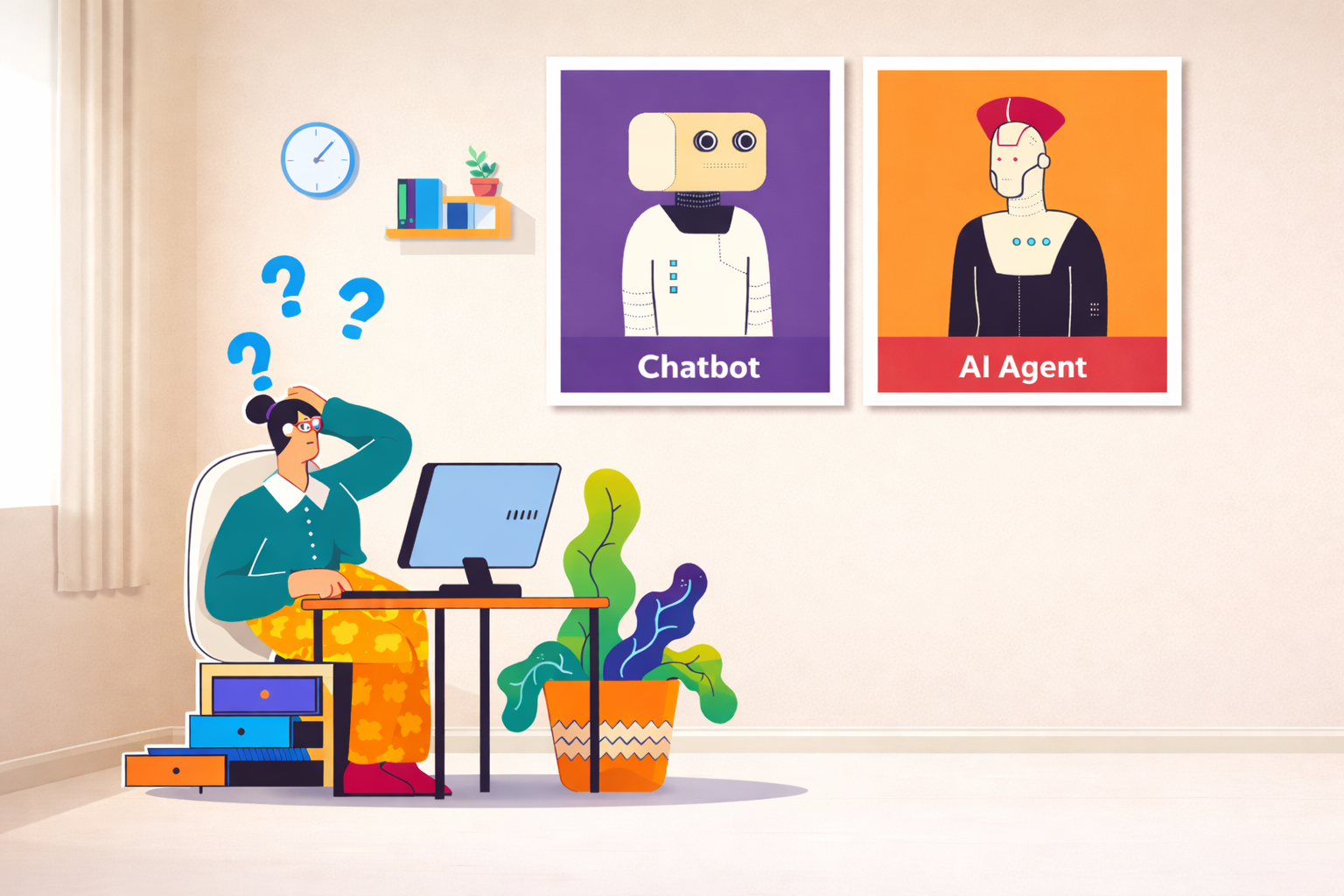
You may have seen Landbot described as a chatbot in some places — and as an AI agent in others.
So which one is it?
Historically, “chatbot” was the dominant term. It described rule-based conversational tools that followed predefined flows. But as generative AI and large language models entered the picture, the industry started shifting toward the term “AI agent” to reflect systems that can reason, act, and interact more dynamically.
Today, both terms are used — sometimes accurately, sometimes loosely.
In this article, we’ll clarify:
- What a chatbot actually is
- What an AI agent really means
- Where the two overlap
- And where Landbot fits today
Let’s get started!
Key takeaways
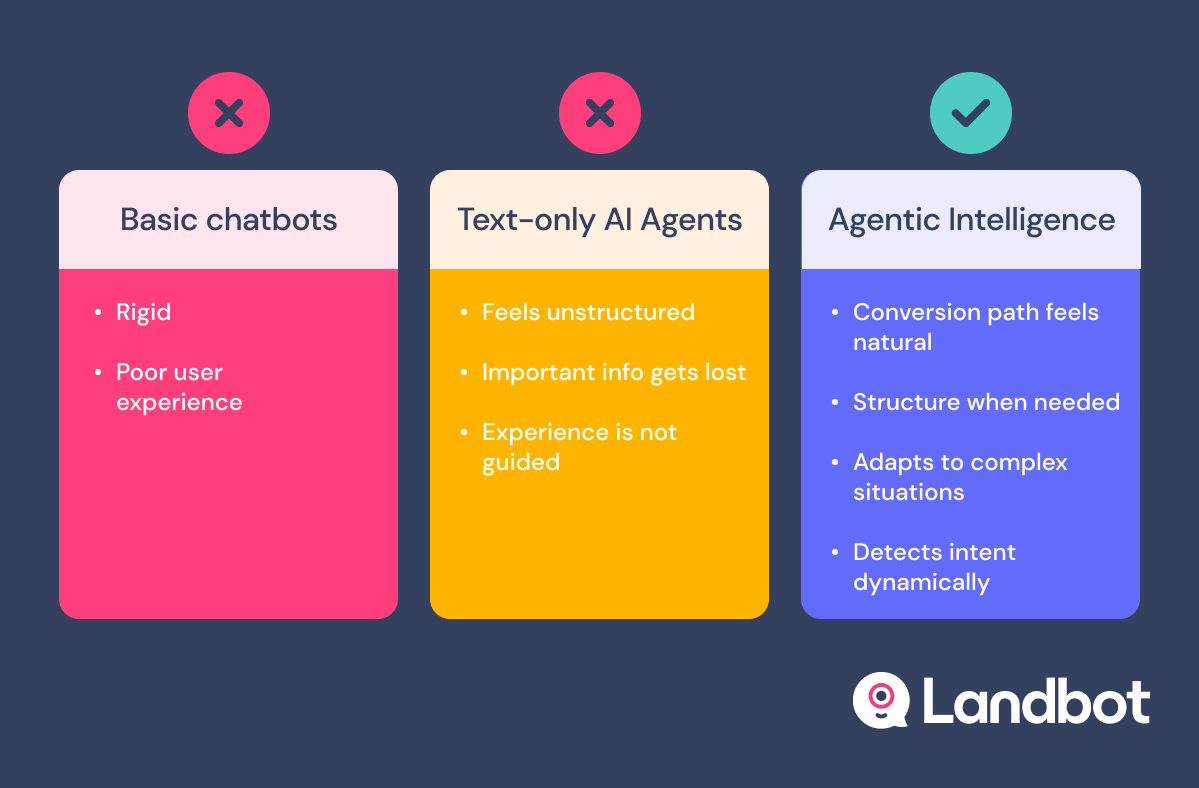
- Most traditional lead generation setups — static pages, forms, rigid chatbots, or text-only AI agents — fail because they lack the right balance between guidance and adaptability.
- Pure AI agents without structure can create unfocused conversations and inconsistent data, while fully scripted chatbots limit flexibility and personalization.
- Landbot combines structured workflows with AI Agent intelligence to guide users clearly while adapting to intent in real time.
- The real conversion lift comes from blending architecture, intelligence, and thoughtful user experience into a single hybrid system.
The Traditional Chatbot Approach
When most people say “chatbot,” they’re referring to a structured, reactive conversational system. At its core, a chatbot follows a simple model:
User input → system response → wait.
The user sends a message. The system processes it, returns an answer, then waits for the next step.
Most chatbots are built using predefined logic or structured flows. You design the paths, define the questions, and determine what happens at each step. That’s what makes them predictable and reliable.
When connected to a LLM, the system still operates within structured logic, but the responses may sound more natural.
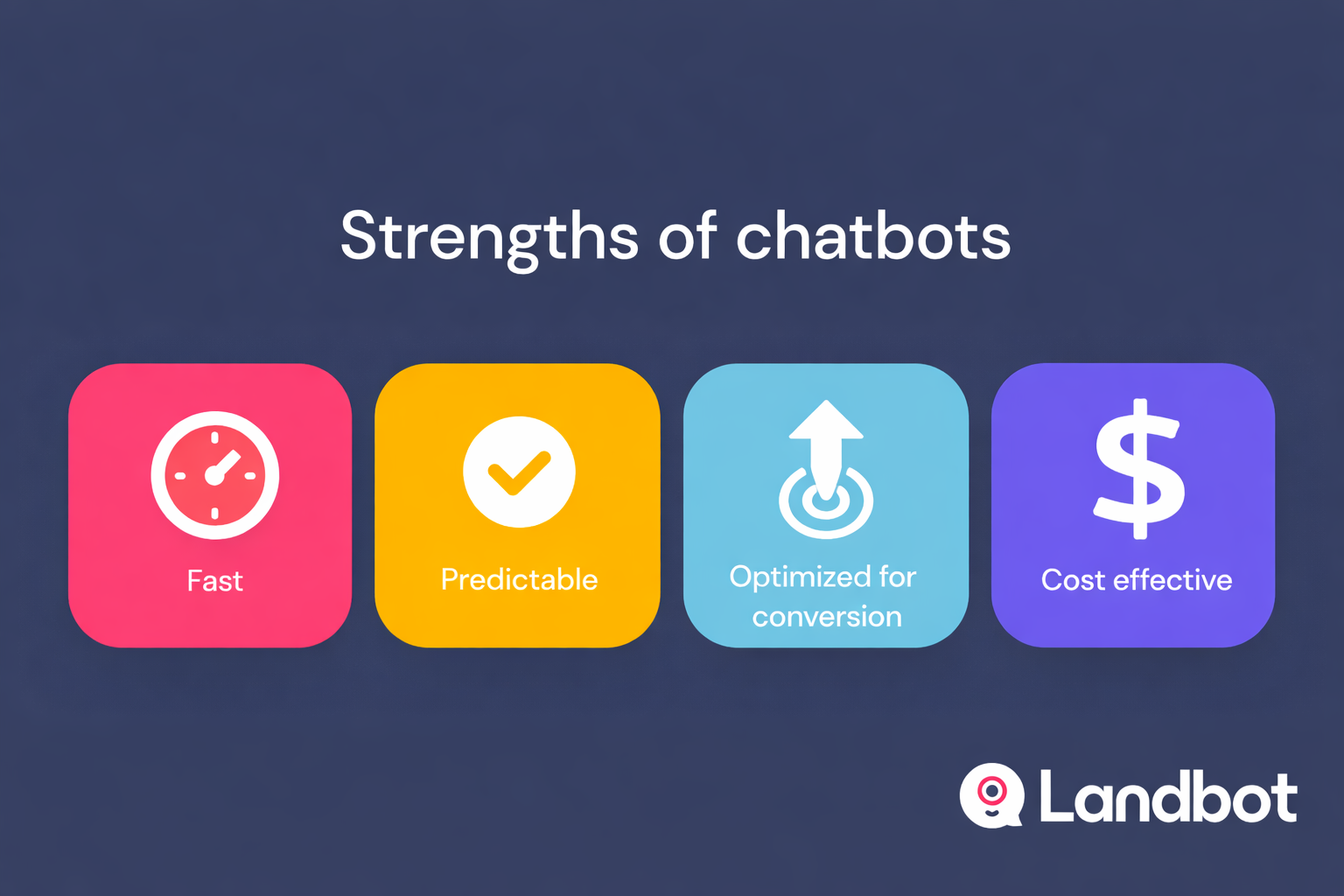
Chatbots are powerful because they are fast, predictable, optimized for conversion, and cost efficient.
Use cases where chatbots excel
If your goal is to qualify leads, collect data, or guide users through a clear path, structured logic ensures nothing is left to chance.
Where chatbots become limited
The challenge appears when conversations stop being linear.
As soon as users deviate from the expected path, introduce ambiguity, change their intent mid-conversation, or require deeper personalization, you need to anticipate and manually map every possible scenario.
Over time, this can make chatbot systems rigid, more complex to maintain, and harder to scale as workflows evolve.
That’s where the concept of an AI agent starts to matter — not as a replacement for chatbots, but as an expansion of what conversational systems can do.
The Agent-Oriented Approach
Now let’s clarify what we mean when we use the term AI agent. The difference can be summarized simply:
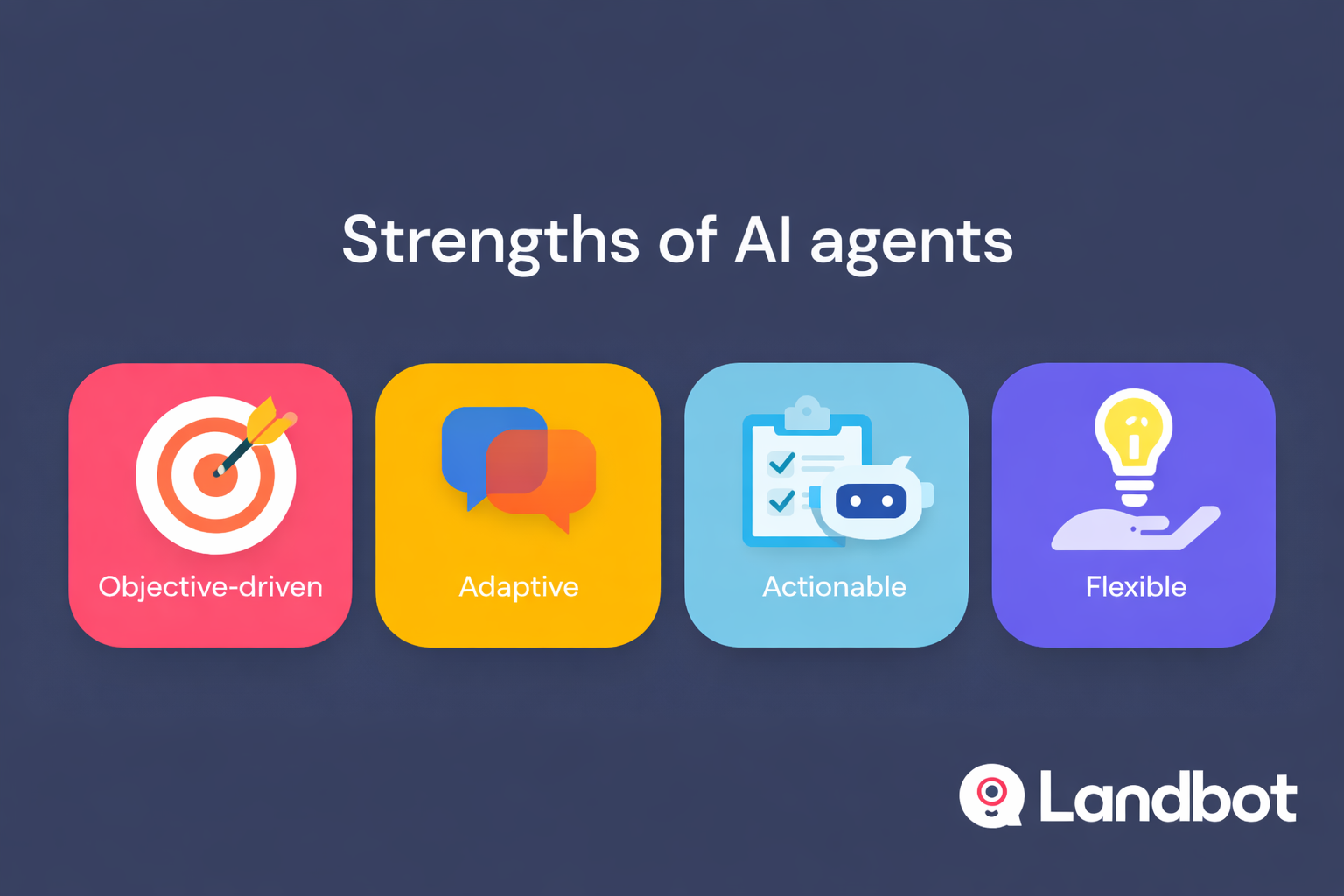
A chatbot responds predictably, but an AI agent works toward an objective.
An AI agent doesn’t just react to the last message. It can adapt as new information appears, it decides what question makes the most sense to ask next and adjusts if the user changes direction. And importantly, it can take action inside connected systems — updating a CRM, triggering a scheduling step, or initiating a workflow — instead of simply generating text.
The experience for the user feels different. There’s less repetition, fewer awkward restarts, more continuity, and more flexibility when things become complex. For example, if someone clarifies their need halfway through the conversation, the system doesn’t have to push them back to the beginning. It can interpret that shift and move forward intelligently.
Use cases where AI agents excel
AI Agents are most effective when conversations are tied to real business objectives and require adaptation, reasoning, and action. They particularly excel in scenarios like the following:
In essence, AI Agents perform best when the conversation is not just informational, but operational — when it is part of a broader workflow that requires context and action.
The current limitations of AI agents
Despite their flexibility and intelligence, AI Agents are not autonomous systems that operate perfectly without structure. They perform best when designed around a clearly defined objective. Without that orientation, even advanced reasoning capabilities can become unfocused or inconsistent.
Additionally, reliability remains critical in business environments. Agents need guardrails — both logical and strategic — to ensure brand alignment, compliance, and predictable behavior. The balance between autonomy and control is essential, especially when agents are interacting with customers or triggering business processes.
Context is another key factor. AI Agents can reason over available information, but their effectiveness depends on the quality, accuracy, and accessibility of that data. Poor inputs or disconnected systems naturally limit performance.
Finally, not every task benefits from full agentic behavior. Highly structured, repetitive processes may still be better served by simpler automation. Intelligence should be applied where it adds value, not complexity.
Why Most Lead Generation Setups Underperform
Most B2B websites still follow the same playbook: a handful of static pages, long explanations about features and benefits, and a “Contact Sales” button at the end. The logic behind this setup seems reasonable — explain everything first, then capture the lead. But that’s rarely how buyers actually behave.
Visitors arrive with specific questions in mind. Your website is where they expect to find answers. Sometimes they do. Other times, they scroll through page after page without finding what they’re looking for. If they’re not fully convinced, they leave. If they’re interested, they’re asked to fill out a form and wait. And that’s where the interaction ends — along with the user’s momentum to convert. They move on, explore alternatives with a smoother experience, and by the time the lead reaches your sales team, it’s already colder than it should be.
To address this, many teams add chatbots. These introduce interaction and generally improve the experience. But when users ask nuanced questions or when intent isn’t immediately clear, traditional chatbots struggle to adapt.
More recently, companies have experimented with fully text-based AI agents. These offer greater flexibility and use AI to enhance responses and capture richer information. However, without structure, conversations can quickly lose focus. Visitors type freely, the system responds in lengthy paragraphs, and important details end up buried in unstructured text.
Different tools. Same outcome.
- Static websites overwhelm.
- Forms create friction.
- Scripted bots limit flexibility.
- Text-only AI agents lack guidance.
And conversion suffers as a result.
The Best of Both Worlds: How to Improve Conversions with Agent Intelligence and Structured Control
Landbot doesn’t ask you to choose between rigid structure and open-ended AI. We recognize that both approaches bring value. That’s why we combine them within AI Agents that preserve the reliability, ease of use, and control traditionally associated with chatbots, while incorporating the flexibility, intelligence, and enhanced user experience that AI Agents make possible.
The structured layer provides direction. It guides visitors step by step, standardizes key inputs, and ensures that the information collected is clean and actionable. Name, company size, role — these aren’t buried in long paragraphs. They’re captured in a format your CRM and sales team can immediately work with.
On top of that structure sits the AI Agent layer. The agent interprets intent, asks follow-up questions based on context, personalizes the conversation, and evaluates qualification dynamically — all while progressing toward a clearly defined objective.
And what about the user experience?
There’s a fine line between flexibility and overwhelming users with too many open-ended questions. The sweet spot lies in delivering an experience that feels structured and focused, while still answering questions and allowing for a more natural conversion path. When appropriate, the AI Agent introduces selectable options or buttons to simplify interaction and reduce cognitive load. When needed, users can also type their own questions and receive contextual responses.
This approach not only improves the experience — it strengthens lead quality. Prospects are qualified before they ever reach your sales team. Those who are not a fit for your solution are not routed forward.
That balance — architecture, intelligence, and experience design — is where conversion begins to improve.
What Hybrid Intelligence Looks Like in Practice
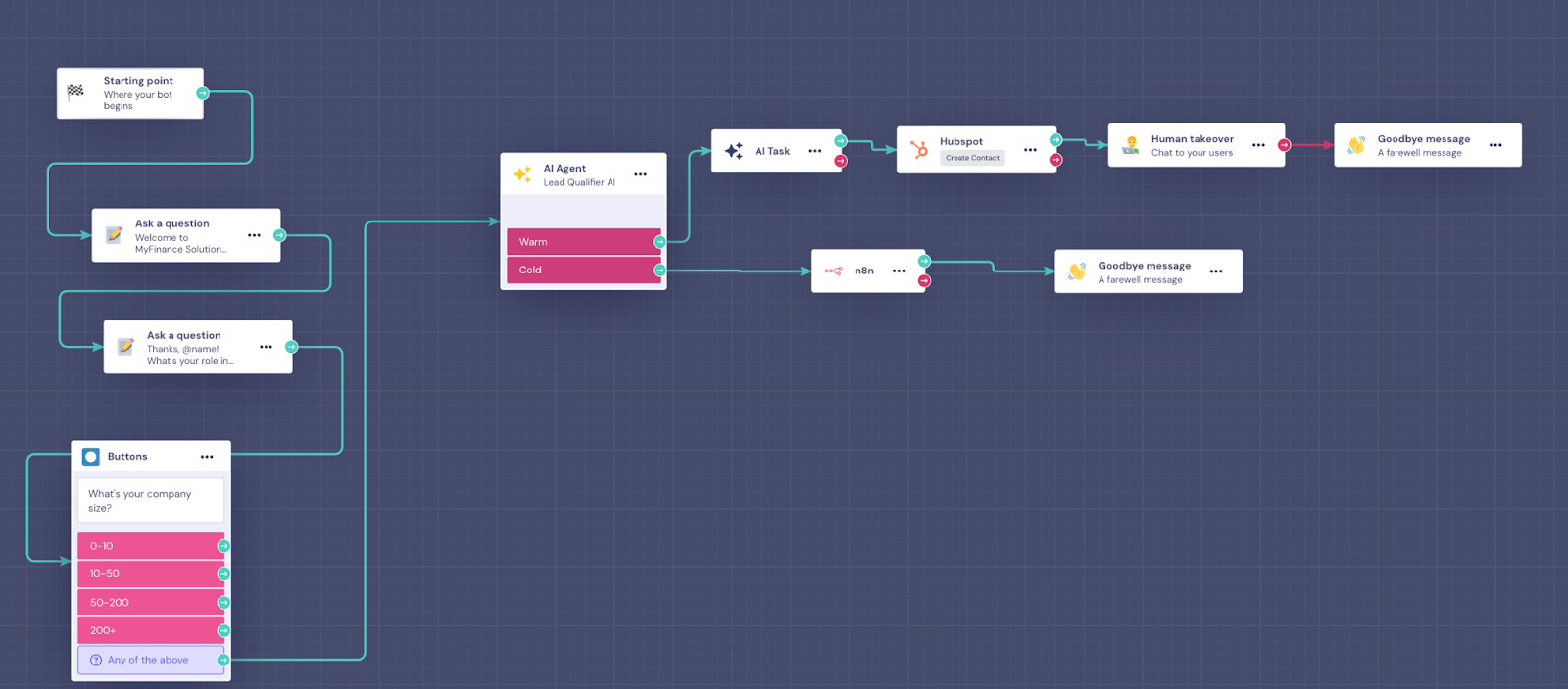
To understand how hybrid workflows operate in practice, let’s look at a concrete example: a lead qualification flow.
1. The structured entry layer
The flow begins with a clearly defined structure.
From the starting point, the system asks a series of predefined questions:
- A welcome message
- The visitor’s name
- The visitor’s role
- Company size (using button-based selection)
This part of the workflow is fully structured. It ensures that essential information is collected in a consistent format and stored correctly. Using buttons for company size, for example, standardizes data and avoids ambiguity.
2. The AI agent layer: Adaptive qualification
Once the foundational data is collected, the interaction moves into the AI Agent block — the adaptive layer of the workflow.
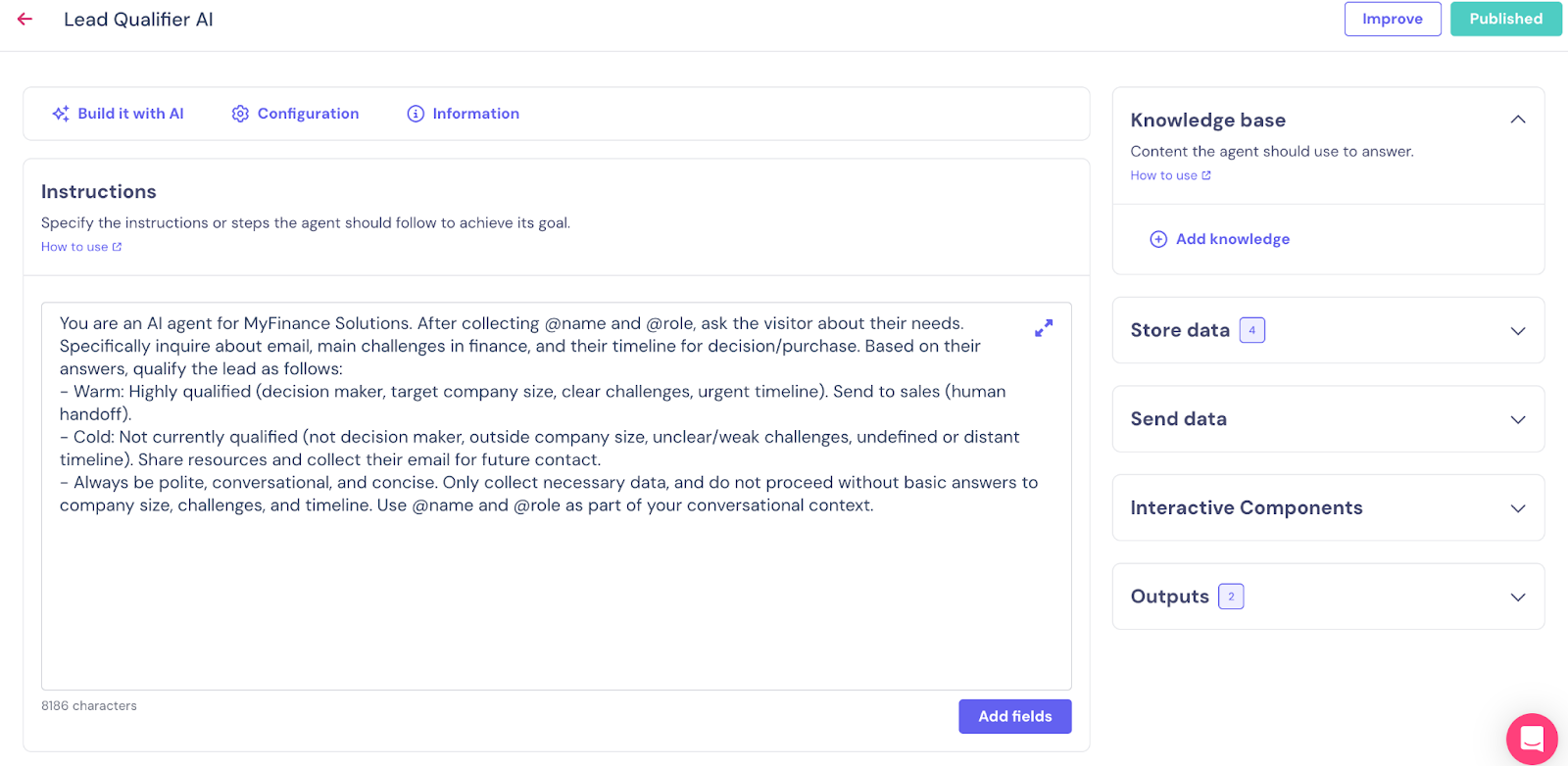
Here, the agent is instructed to:
- Ask for the visitor’s email
- Inquire about their main financial challenges
- Understand their timeline for decision or purchase
Based on these answers, the agent evaluates the lead and classifies it as Warm or Cold.
Inside this block, several capabilities come into play:
- It can use conversational and business context to guide the interaction.
- It can store collected information as structured variables.
- It can integrate a knowledge base if domain-specific information is required.
- It can include interactive components (such as buttons) to balance open text with structured inputs.
- It outputs a clear qualification decision: Warm or Cold.
This is where adaptability is introduced. The agent determines how to move the conversation forward based on intent, context, and progress toward the qualification objective.
3. Warm lead path: Intelligence + human collaboration
If the lead is classified as Warm, the workflow continues with an additional AI task.
This task:
- Summarizes the lead profile
- Generates a concise note for the sales representative
- Highlights relevant context, challenges, and suggested angles for conversation
The summarized information is then sent to HubSpot to create or update the contact and routed to a human representative for takeover.
If no human is immediately available, the system communicates clearly that follow-up will happen via email. The process remains structured and reliable, while still benefiting from AI-generated context.
4. Cold lead path: Automated nurturing
If the lead is classified as Cold, the workflow follows a different path.
The collected data is sent to an automation in n8n, where the contact is enrolled in a nurturing email sequence. A closing message is delivered within the conversation.
This ensures that even non-qualified leads are handled intentionally, without requiring manual intervention.
Defining the Architecture of Modern Conversations
The way conversational software is being built is changing. Static, predefined interactions are gradually giving way to systems that can reason, adapt, and take action within real business processes.
As expectations rise, conversations are no longer evaluated solely by how natural they sound, but by how effectively they contribute to meaningful outcomes. Intelligence is becoming operational — embedded within workflows, connected to systems, and aligned with business objectives.
Landbot sits within that shift. By combining structured control with agent-level intelligence, it supports complex use cases while remaining reliable and intentional by design. The result is a model that embraces adaptability without sacrificing clarity, and intelligence without losing control.
If you’re exploring how this hybrid approach could work in your own processes, you can explore Landbot and start building a flow tailored to your needs.
FAQs about Landbot as an AI Agent
What is Landbot as an AI agent platform?
Landbot is a conversational AI platform that combines structured workflows with AI Agent capabilities. Instead of relying solely on scripted chatbot logic or fully open-ended AI conversations, it integrates both approaches within a single system. This allows businesses to guide users through clear, structured paths while still benefiting from adaptive reasoning, contextual personalization, and automated qualification.
Can Landbot replace forms with AI agents?
Yes. Landbot can replace traditional “Contact Sales” forms with conversational AI Agents that collect structured information interactively. Instead of asking users to fill out static forms and wait for follow-up, the AI Agent guides visitors step by step, captures validated inputs (such as role, company size, and intent), and qualifies leads dynamically. This reduces friction, improves data quality, and maintains user engagement.
What are the best use cases for Landbot AI agents?
Landbot AI Agents perform best in use cases where conversations are tied to operational outcomes, such as:
- Lead qualification and routing
- Demo booking
- Customer support triage
- Onboarding and guided flows
They are particularly effective when businesses need both structured data capture and adaptive conversation logic.
How do Landbot AI agents work for SaaS companies?
For SaaS companies, Landbot AI Agents help bridge the gap between marketing and sales. They engage website visitors in real time, understand intent, qualify prospects before routing them to sales, and connect directly with CRM systems and automation tools. This ensures that sales teams receive contextualized, higher-quality leads.
What are the pros and cons of using AI agents for lead generation?
AI Agents can significantly improve engagement and qualification when implemented correctly. They adapt to user intent, personalize responses, and automate operational follow-up. However, fully text-based AI agents without structure can lead to unfocused conversations and inconsistent data capture. The most effective implementations combine intelligent reasoning with guided interaction design — balancing flexibility with control.
.jpg)


.avif)

.avif)
%20(1).png)
.avif)