


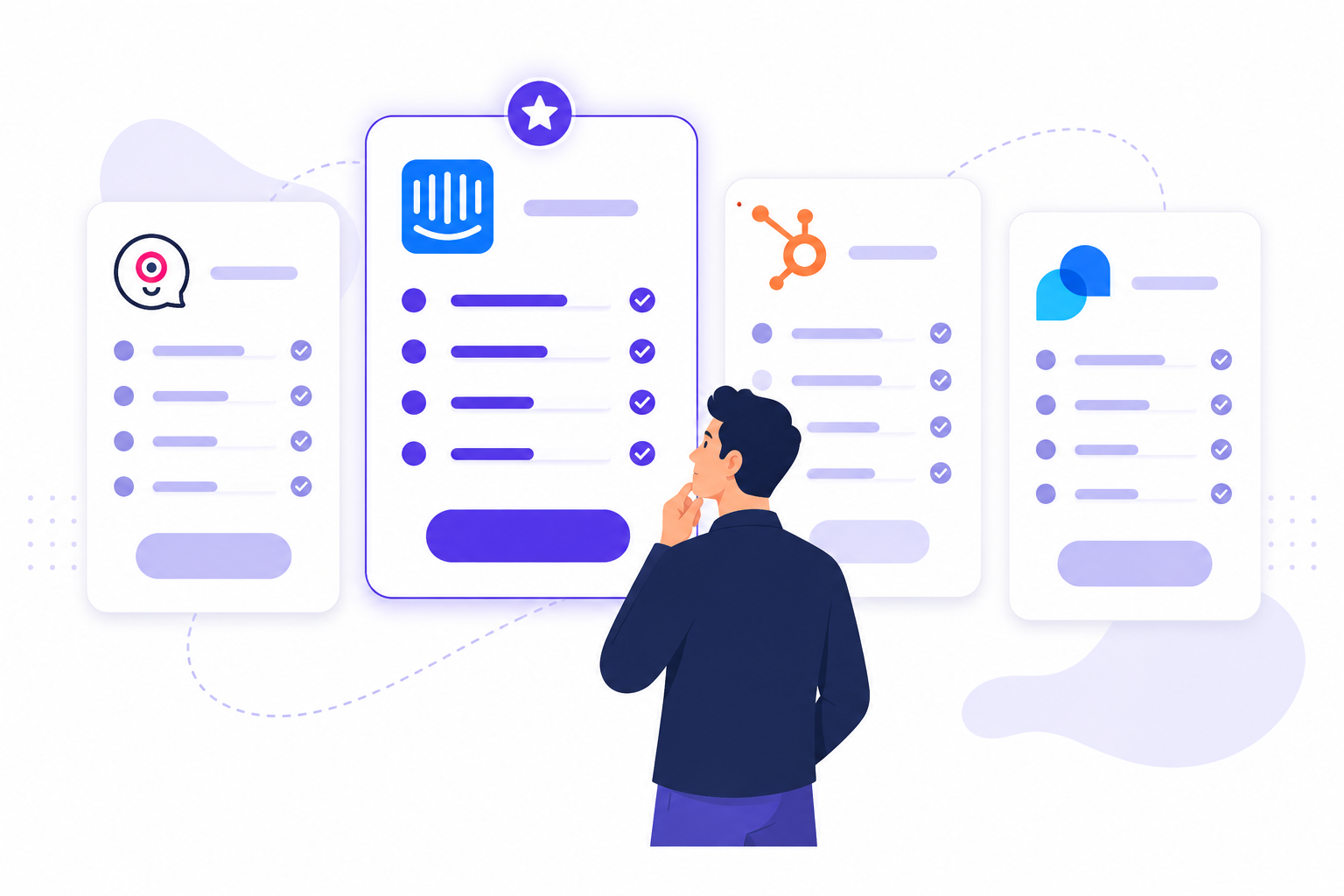
Most searches for Intercom alternatives don't start because Intercom is a bad product — it isn't. They start because Intercom is a broad platform: chat widget, shared inbox, help desk, knowledge base, AI agent, outbound messaging. Very few teams use all of it. If you're mainly running one of those jobs — capturing leads on your website, or resolving support tickets — a tool built specifically for that job will usually fit better than a suite built for all of them.
Below, the 10 options are grouped into four jobs — lead generation, customer support, budget all-in-ones, and specific stacks — each with pricing verified on the vendor's own pricing page, honest pros and cons, and a clear verdict. Find your job, then pick from the tools built for it.
Key Takeaways
- Teams rarely leave Intercom because it's broken — they leave because they're paying for a full suite while using one slice of it, and a focused tool fits that slice better.
- There is no universal winner — the best Intercom alternative depends on whether your job is lead generation, customer support, or both on a tight budget.
- For lead generation, Landbot and Tidio are the strongest picks; for support inboxes, look at Help Scout, Front, Zendesk, or Freshdesk.
- Crisp and HelpCrunch deliver the most features per dollar; Chatwoot is the open-source, self-hosted path; HubSpot wins if your CRM is already HubSpot.
- AI resolution pricing varies widely across tools — from €0.45 to €0.99 per resolution — so high-volume teams should model usage costs, not just seat costs.
- Intercom is still the right choice for support-led teams that want a help desk, knowledge base, and best-in-class AI agent in one platform.
Intercom Alternatives at a Glance
Here's how the 10 tools compare on the dimensions that matter most when switching. Prices reflect annual billing as of June 2026 — always confirm on the vendor's pricing page before committing.
Best Intercom Alternatives for Lead Generation and Conversion
If Intercom's chat widget is sitting on your marketing site to capture and qualify visitors — not to resolve tickets — these two tools are built around exactly that job: turning traffic into pipeline.
1. Landbot — Best for No-Code Lead Generation Automation
Yes, we built Landbot — so read this section knowing exactly where it comes from. Here's our honest take on when we're the right Intercom alternative, and when we're not.
Landbot is an agentic website conversion platform: you build AI agents and conversational flows in a visual, no-code builder, embed them on your website or connect them to WhatsApp, and they qualify, engage, and convert visitors automatically. Where Intercom treats chat primarily as a support channel, Landbot treats it as an acquisition channel. The key difference for marketing and revenue teams: you control the full flow yourself — conditional logic, webhooks, native HubSpot and Salesforce sync — without depending on your dev team, and the AI agent says exactly what you define, handing off to a human when the conversation needs it.
Pros:
- No-code depth that doesn't limit you: conditional logic, custom CSS, webhooks, API access, and AI in one builder.
- AI agents stay within the flow you define — no improvising outside scope, which matters when an agent is talking to leads.
- Web and WhatsApp from the same platform, with native CRM integrations that sync data back without code.
Cons:
- Not a full help desk — there's no multi-agent ticketing system with SLAs.
- Chat-based pricing means high-traffic sites need to forecast volume and watch per-chat overage rates once they exceed a plan's included chats.
- Support-side analytics are lighter than Zendesk-class suites.
Pricing: free Sandbox plan (1 seat, 100 chats/month); Starter from €32/month billed annually (€40 billed monthly — 500 chats, two seats, 100 AI chats); Pro at €80/month billed annually adds API access and higher volumes.
Best for: marketing and revenue teams that want to turn website and WhatsApp traffic into qualified pipeline — without code. Who shouldn't choose Landbot: if your main job is resolving support tickets at volume with a shared team inbox, pick Help Scout, Front, or Zendesk instead.
2. Tidio — Best for Small E-Commerce Stores
Tidio targets the small online store: a chat widget, ready-made automation templates, and the Lyro AI agent for deflecting repetitive pre-sale and shipping questions. Setup takes minutes, and the Shopify integration is very good.
Pros:
- Free plan and a quick, template-driven setup.
- Lyro AI handles FAQ-style deflection well for stores with predictable question patterns.
- Deep Shopify and WooCommerce integrations (cart data, order status in chat).
Cons:
- Lyro is effectively a separate add-on from €32.50/month billed annually for 50 AI conversations — it can double a small store's bill.
- A steep pricing cliff between Growth (from €49.17/month) and Plus (from €300/month) with nothing in between.
- B2B lead qualification tooling is shallow — it's built for shopper questions, not pipeline.
Pricing: free plan; Starter at €24.17/month and Growth from €49.17/month billed annually (€29 and €59 billed monthly); Lyro AI from €32.50/month extra.
Best for: small e-commerce stores that want fast, affordable chat and FAQ automation — not B2B lead gen.
Best Intercom Alternatives for Customer Support and Shared Inboxes
If your team lives in Intercom's inbox resolving conversations, these four are the serious contenders — from the simplest (Help Scout) to the most enterprise-grade (Zendesk), with Front and Freshdesk in between.
3. Help Scout — Best for Email-First Customer Support
Help Scout is what many teams wish Intercom still was: a focused, humane support tool without the platform sprawl. It centers on a shared inbox, a knowledge base (Docs), and just enough automation — with one of the gentlest learning curves in the category.
Pros:
- Genuine free plan (up to 5 users, 1 inbox) and transparent paid tiers — rare in this market.
- AI Answers priced at a flat $0.75 per resolution, simpler to forecast than most rivals.
- Fast onboarding: most teams are productive in a day, no admin specialist needed.
Cons:
- Light on proactive lead capture — there's no visual flow builder for qualifying visitors.
- Channel coverage is narrower than omnichannel suites (email and chat first).
- Workflows and advanced integrations are locked out of the free plan.
Pricing: free plan available; paid from $25/user/month billed annually (Standard), Plus at $45, Pro at $75.
Best for: SMB support teams that live in email and want Intercom's core inbox experience at a predictable per-user price.
4. Front — Best Shared Inbox for Team Collaboration
Front rebuilt the email client for teams. If your customer communication happens mostly over email — with multiple people needing visibility, assignments, and internal discussion on the same thread — Front does that better than Intercom or any tool on this list.
Pros:
- Best-in-class email collaboration: internal comments, assignments, and shared drafts on real email threads.
- Strong automation and analytics on the Professional tier.
- Feels like email, so adoption friction is near zero for sales and account teams.
Cons:
- No free plan, and the $25 Starter tier is capped at a single channel type and 10 seats.
- AI features (Copilot, Smart QA) are paid add-ons on lower tiers and can roughly double the cost.
- Less suited to high-volume anonymous website chat — it's built around known contacts.
Pricing: from $25/seat/month billed annually (Starter); Professional at $65/seat unlocks omnichannel; Enterprise at $105/seat.
Best for: teams managing customer relationships over email — account management, logistics, B2B services — that need a true collaborative inbox.
5. Zendesk — Best for Enterprise Support Operations
Zendesk is the incumbent Intercom alternative for serious support operations: deep ticketing workflows, a huge app marketplace, mature compliance, and reporting that satisfies an ops director. It's not a lighter option than Intercom — it's a different weight class.
Pros:
- The deepest ticketing, routing, and SLA tooling in the category.
- Massive marketplace and mature APIs for complex stacks.
- Enterprise-grade compliance, security, and multi-brand support.
Cons:
- Costs stack fast: Copilot alone adds €50/agent/month on top of any Suite plan, and AI agents bill per resolution.
- Real administration burden — most teams need a dedicated Zendesk admin.
- Overkill for SMBs that just need chat plus a simple inbox.
Pricing: Support Team from €19/agent/month billed annually; Suite Team at €55; Professional at €115; Enterprise negotiated.
Best for: mid-market and enterprise support organizations with dedicated ops resources and compliance requirements.
6. Freshdesk — Best Value for Traditional Ticketing
Freshdesk (by Freshworks) covers the classic help desk feature set — tickets, knowledge base, SLAs, automations — at consistently lower price points than Zendesk or Intercom, plus a free starter program for very small teams.
Pros:
- Free for up to 2 agents during the first 6 months; paid ticketing from just €17/agent/month.
- Freddy AI agent includes 500 sessions on Pro and Enterprise plans to start.
- Solid omnichannel option (Freshdesk Omni) if you grow into chat and social.
Cons:
- Freddy AI pricing gets complex: Copilot is a separate paid add-on, and extra AI agent sessions cost €45 per 100.
- Omnichannel plans are a separate, pricier track (€29–€115/agent).
- Parts of the UI and reporting feel dated next to newer tools.
Pricing: €0 for 1–2 agents for the first 6 months; paid from €17/agent/month billed annually (Growth), Pro at €52, Enterprise at €84; Omni plans from €29/agent.
Best for: budget-conscious teams that want a traditional ticketing help desk with room to grow into AI and omnichannel later.
Best All-in-One Intercom Alternatives on a Budget
These two won't match Intercom feature-for-feature, but they cover a surprising share of it — chat, inbox, knowledge base, campaigns — at prices a bootstrapped team can defend.
7. Crisp — Best Budget All-in-One
Crisp's pitch is simple: almost everything Intercom does — shared inbox, knowledge base, campaigns, even co-browsing — priced per workspace instead of per seat. For a 6–10 person team, that pricing model alone can cost a fraction of what per-seat tools charge.
Pros:
- Workspace pricing: the Essentials plan at €95/month includes up to 10 seats at no extra cost.
- Permanent free plan with 2 seats — not an expiring trial.
- Wide feature surface for the price: chatbot builder, campaigns, status page, and multi-channel inbox.
Cons:
- Unlimited AI usage only arrives on the Plus plan (€295/month); lower tiers cap AI heavily.
- The interface can feel busy once you enable many modules.
- Roles and permissions are thinner than enterprise tools — a stretch for larger support orgs.
Pricing: free (2 seats); Mini at €45/workspace/month, Essentials at €95, Plus at €295 — all per workspace, not per seat.
Best for: cost-conscious teams that want the broadest Intercom-style feature set for a flat, predictable monthly price.
8. HelpCrunch — Best Per-Seat Price for Startups
HelpCrunch bundles live chat, a help desk, a knowledge base, and email marketing into one of the lowest per-seat prices in the category. For an early-stage startup replacing Intercom's basics, it covers a surprising amount of ground for €12 a head on annual billing.
Pros:
- Chat, help desk, knowledge base, and email campaigns from €12/user/month billed annually.
- Clean, modern interface with little training required.
- Email automation included — useful for small teams consolidating tools.
Cons:
- AI allowances are small: Pro includes 50 AI conversations, then paid add-ons from €23.20/month per extra 100.
- No free plan — trial only.
- Smaller integration ecosystem than the bigger names on this list.
Pricing: Basic at €12/user/month billed annually (€15 monthly), Pro at €20 (€25 monthly), Unlimited at €495/month billed annually (€620 monthly).
Best for: startups that want the cheapest credible per-seat replacement for Intercom's chat and inbox basics.
Best Intercom Alternatives for Specific Stacks and Setups
Two picks where the deciding factor isn't features — it's your existing situation: a stack that already runs on HubSpot, or a requirement to keep customer data on your own servers.
9. HubSpot — Best for HubSpot-Native Teams
If your CRM, marketing automation, and reporting already live in HubSpot, adding its chat and service tools beats bolting on a separate platform. Every conversation lands on the contact record automatically, and the Breeze customer agent works from the CRM context you already maintain.
Pros:
- Free tier includes live chat and rule-based chatflows — a working starting point at €0.
- Breeze customer agent is outcome-based: a resolved conversation costs 50 credits — €0.45 at HubSpot's credit rate.
- Unbeatable CRM context: routing, personalization, and reporting use data you already have.
Cons:
- Breeze agents require Professional or Enterprise seats (€90–€150/seat/month) plus HubSpot Credits — the “seats + credits” math needs modeling.
- As a standalone chat tool (without the CRM), it's weaker than dedicated alternatives.
- Service Hub Enterprise carries a required one-time €3,420 onboarding fee.
Pricing: free chat tools; Service Hub Starter from €7/seat/month, Professional at €792/month (includes 3 seats), Enterprise at €3,300/month (includes 5 seats), billed annually — per HubSpot's pricing page.
Best for: teams already running on HubSpot CRM that want chat, support, and AI resolution inside one ecosystem.
10. Chatwoot — Best Open-Source Alternative
Chatwoot is the self-hosted answer to Intercom: an open-source customer engagement platform you can run on your own infrastructure, with unlimited seats and full data control. For companies with strict data residency or GDPR requirements — and an engineer to spare — it's the most autonomous option here.
Pros:
- Community edition is free to self-host with no seat limits — total cost is your infrastructure.
- Full data ownership: conversations never leave your servers.
- Affordable cloud option from $19/agent/month with Captain AI credits included.
Cons:
- Self-hosting means you own uptime, upgrades, and security patches.
- Captain AI, SSO, and advanced roles sit behind paid tiers even when self-hosted.
- Fewer native integrations than commercial rivals — expect to build some glue yourself.
Pricing: self-hosted Community edition free forever; cloud has a free Hacker tier (up to 2 agents, 500 conversations/month), then Startups at $19/agent/month, Business at $39, and Enterprise at $99 — billed annually.
Best for: technical teams that need full data control or self-hosting — and have the resources to operate it.
When Intercom Is Still the Right Choice
An honest comparison has to say this: sometimes the best Intercom alternative is Intercom. If you're a support-led organization that wants a help desk, knowledge base, proactive messaging, and an AI agent in one tightly integrated platform, switching may cost you more in migration effort than you'd gain. The teams who should switch are those using one slice of the platform while paying for all of it — that's where a focused tool wins on both cost and fit.
How to Choose the Right Intercom Alternative
The groups above answer the first question — which job you're hiring the tool for. Before you commit to a specific tool inside your group, run three more checks:
- Model the AI usage cost, not just the plan price. Per-resolution and per-conversation AI pricing (€0.45–€0.99 across these tools, plus capped AI allowances on others) is where bills quietly grow. Estimate your monthly conversation volume and do the math for each shortlisted tool — including overage rates.
- Weigh the channel mix. If WhatsApp matters in your market, shortlist tools where it's native rather than an afterthought. If email is your main channel, an email-first tool will beat a chat-first one every time.
- Ask about the migration path. Swapping a chat widget is a one-day job; migrating knowledge base articles, saved replies, and ticket history is not. Ask each vendor for their Intercom import tooling before you commit.
And whichever direction you lean, run a real trial with your actual flows — visitors who engage in chat are 2.8 times more likely to convert, so the quality of that first conversation is worth testing, not assuming.
Frequently Asked Questions
What is the cheapest Intercom alternative?
It depends on team size. For one or two people, Crisp's permanent free plan, Chatwoot's free Hacker tier, or Landbot's Sandbox plan cost nothing. For teams of 5–10, Crisp's per-workspace pricing usually beats every per-seat tool — 10 seats on Essentials works out to €9.50 per person. If you have engineering capacity, self-hosted Chatwoot is the cheapest at any scale, since you only pay for servers.
Why do teams switch away from Intercom?
The most common reason is scope mismatch, not dissatisfaction: a team adopts Intercom for one job (say, website chat), the platform grows around them, and eventually they're maintaining — and paying for — capabilities they never use. The second reason is forecastability: usage-based AI charges make budgets harder to predict as volume grows, which is true of most platforms in this category, so teams switch to whichever pricing model matches how they operate.
Can I replace Intercom for lead generation only and keep my help desk?
Yes, and it's a common pattern: a conversion-focused tool like Landbot runs on your marketing site to qualify and route leads, while your existing help desk keeps handling tickets behind the login. The two connect through native integrations or webhooks, so qualified leads land in your CRM and support questions land in your queue — each tool doing the job it's best at.
How hard is it to migrate away from Intercom?
Swapping the chat widget itself is typically a one-day job — embed the new snippet and you're live. The longer work is migrating history: knowledge base articles, saved replies, and ticket archives. Most tools on this list offer importers or migration support for exactly this, so ask the vendor for their Intercom migration path before you commit.
Which Intercom alternatives support WhatsApp?
Landbot, Crisp, Tidio, Chatwoot, and Zendesk all offer WhatsApp channels. The difference is depth: most treat WhatsApp as another inbox channel, while Landbot lets you run the same automated qualification flows on WhatsApp that you run on your website — relevant if WhatsApp is an acquisition channel in your market rather than just a support line.
Is an AI agent worth the per-resolution price?
Do the math against your cost per ticket: if a human resolution costs you €4–8 in agent time and an AI resolution costs €0.45–€0.99, automation pays for itself quickly at volume — provided the AI actually resolves rather than frustrates. Whatever tool you pick, insist on controlling the flow: an agent that improvises outside its defined scope creates brand risk that no per-resolution discount offsets.
Find the Intercom Alternative That Fits Your Job
The search for an Intercom alternative usually ends the same way it started: with a clear picture of what you actually need. If that's enterprise ticketing, go Zendesk. If it's a calmer inbox, go Help Scout or Front. And if the real goal is turning the traffic you're already paying for into qualified pipeline — without writing code or waiting on your dev team — that's exactly what we built Landbot for. Try Landbot free and see how many of your visitors were ready to talk all along.
.png)


.jpg)
.avif)
%20(1).png)
.avif)